This One Question From A Buyer Changed How We Design Bags
Featuring sustainable solutions by Kelvin Ecopack
We are usually asked the same questions by buyers during meetings and visitors during trade fair shows. Our conversations usually start with:
“What’s the price per bag?”
“What materials do you use?”
“How quickly can you deliver?”
While these questions are important and hold great significance, during a trade fair show, a question from a visitor stood out because the discussion went far beyond specifications. During a discussion with a potential buyer who was evaluating our sustainable bag solutions, we had just finished discussing and reviewing samples made from Jute, Juco, Cotton and Canvas. The conversation had covered prices according to MOQ, printing options, bag designs and production timelines. After which, he asked a question that changed how we think about bag design.
“If our demand grows globally, can this sustainability solution scale with us?”
This sounds like a simple question but it carries a powerful implication. This means that the buyer wasn’t just looking for a sustainable solution that could support global growth. This moment completely reshaped our perspective and approach towards our bag designs.
Sustainability Isn’t Just About Materials
Many discussions with our visitors were based primarily on packaging and pricing. This is justified because these points do play a huge role in reducing environmental impact. This question from our potential buyer reminded us of something deeper, a sustainable solution should not only work today but it should also be able to grow with the company.
A bag may start with an initial order of 20,000 pieces but what happens when the demand increases to hundreds, thousands or even millions of units across multiple countries. If sustainability cannot scale it will eventually become a bottleneck rather than a solution. This is When we re-think our approach. Instead of designing bags only for the current requirement, we start working on designing solutions that can grow with the brands we work with.
What Do We Mean by Designing for Scale?
Scaling a sustainable bag solution adds to more than just rise in production numbers. It must include a strong hold in the following areas:
1. Reliable Natural Materials
We design solutions and manufacture bag solutions made up of Jute, Juco, Cotton and Canvas. These materials are known to be renewable, eco-friendly, durable and biodegradable. Amongst all the materials, Jute stands to be one of the most sustainable fibres in the world.
Here are some interesting facts about jute fibre:
- Jute plants grow in just 4-6 months, making them one of the fastest renewable fibers.
- They require minimal fertilizer and pesticide. Jute cultivation helps improve soil health.
- During cultivation, Jute, which is also commonly known as the golden fibre, absorbs significant amount of carbon dioxide.
Renewable fibers like these, offer both environmental benefits and supply stability, especially for brands looking to scale sustainable packaging globally.
2. Developing Bags for Long Term Use
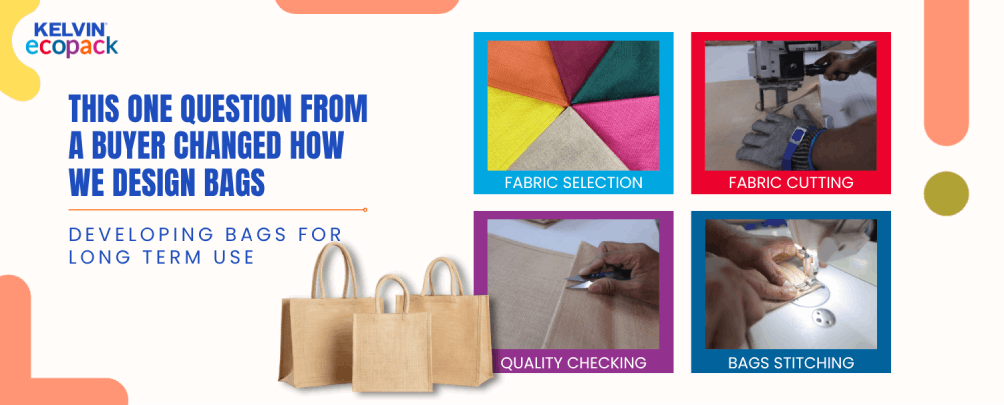
Sustainability is directly related to the durability of a packaging solution. A bag that tears or loses its colour after a few uses may be eco-friendly but not be able to deliver its purpose to the fullest. Studies suggest that a well-made reusable bag replaces hundreds of single use plastic bags during its lifespan True sustainability depends on how long a product stays in use. Therefore, we focus on reinforced handles, strong stitching, durable fabric selection and long-lasting printing quality. People continue to re-use the most sustainable solutions which also keeps the circulation of brand name for years.
3. Scaling Without Compromising on Quality
Consistency plays a very critical role for international brands. A bag purchased in one country should look and perform the same as a bag purchased in another. This would mean maintaining strict standards for the quality of materials, stitching strength, printing precision and product finishing. Scaling responsibly requires a manufacturing process that ensures the same reliability at every stage of growth.
4. The Strategic Marketing Power of Reusable Bags
Reusable bags extend their value way past the store. The productive of a bag for a brand begins when it reaches the hands of a customer. A thoughtfully designed reusable bag stays in use for years becoming a constant companion rather than a one-time use bag. This prolonged lifestyle means that the brand continues to be seen, remembered and experienced long after the initial transaction. In many ways, a reusable bag evolves into a mobile brand asset that does not just carry products but the identity, values and visibility of your brand, wherever it goes.
Why would Packaging Decisions Today, Define Brand’s Tomorrow?
The buyer’s question also reflected a much larger trend. Businesses are moving away from single use plastic bags and exploring packaging alternatives that are more sustainable and planet- friendly. Governments are also coming up with stricter regulations. Consumers are becoming more aware about the environment and brands are mostly expected to demonstrate visible sustainability efforts. They are also preparing for future expectations. They have become a strategic decision for brands operating in global markets. Brands that are working with sustainable packaging today are not only reducing environmental impact but they are preparing themselves for the expectations of tomorrow.
A Question That Changed Our Thinking Completely
We came to an understanding that the buyer’s question was not really about bags, rather it was about responsibility, foresight and long-term partnership. “If our demand grows globally, can this sustainability solution scale with us?” This reminds us that true sustainability must grow alongside the brands we support. This insight continues to shape how we previously use to design bags. Our goal is to produce eco-friendly bags that can support responsible growth, Locally and Globally. We believe that when a product is designed with thought and vision, it carries the future of responsible packaging.
Frequently Asked Questions:
1. Can sustainable packaging solutions scale for international retail chains?
Ans. Yes, sustainable packaging can scale globally when it receives proper support from reliable sourcing, consistent quality and strong production systems. Jute, Juco, Cotton and Canvas are known to be well-suited eco-friendly and biodegradable materials for larger volumes, which also makes them ideal for international retail expansion.
2. Which eco-friendly material is best for high-volume reusable bags?
Ans. Jute and Canvas are among the best options for high-volume reusable bags. This is because Jute is a fast growing, strong and biodegradable fibre, while Canvas offers durability with premium finish. This makes both these materials well-suited for large-scale use.
3. How does the durability of a reusable bag impact its sustainability?
Ans. Durability is known to be a key to sustainability because a bag that lasts longer and can be reused multiple times helps to bring down wastage and reduce the use of single use plastics more effectively. The longer the bag is used, the lower will be the environmental impact.
4. What are the marketing benefits of switching to branded reusable bags?
Ans. Reusable bags act like mobile brand ambassadors. Not only are they capable of increasing brand visibility, improve recall and position the brand as environmentally responsible but they also stand out and look stylish, if designed accordingly. These bags also offer long-term marketing value, much beyond the initial use. They add to the goodwill of the brand.
5. Why should businesses prioritize scalable eco-friendly packaging now?
Ans. Businesses should prioritize scalable and eco-friendly packaging due to rise in environmental regulations and growing consumer awareness. Now, companies should come up with solutions that are both scalable and sustainable. Hence, adopting eco-friendly packaging would help brands to stay competitive, compliant and ready for the future.