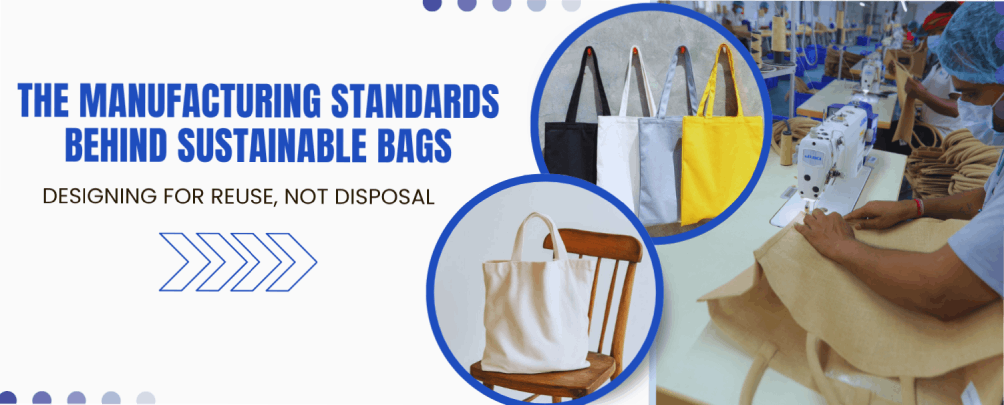
The Manufacturing Standards Behind Sustainable Bags
Featuring sustainable solutions by Kelvin Ecopack
Introduction
Sustainable bags are no longer a niche product. Consumers are looking past appearances in corporate gifting, global retail and responsible packaging. Durability, ethical production and environmental accountability is important to them.
In today’s export market, sustainability is not defined only by the fabric used. It is defined by the standards followed during manufacturing — from sourcing and production to labour practices and waste reduction.At Kelvin Ecopack, sustainability is approached as a disciplined process, built into every stage of bag manufacturing.
Responsible Material Selection and Traceability
The first sustainability standard begins with raw materials. Natural fibres such as Jute, Juco, Cotton and Canvas are widely preferred because they are renewable and reusable when produced correctly.
Studies in textile manufacturing show that nearly 60 to 70 percent of a product’s durability and environmental performance is determined at the raw material stage. This is the reason why responsible manufacturers focus on consistent fabric quality, reliable sourcing and material traceability rather than surface-level eco claims.
A sustainable bag must start with a material that is made to last.
Designing for Reuse, Not Disposal
The most measurable sustainability factor is product lifespan.
Research consistently shows that reusable bags deliver environmental benefit only when they are used repeatedly — often 10 to 20 uses are enough to outperform single-use alternatives. This makes durability a core manufacturing requirement.
Strong stitching, reinforced handles and high-load construction are not premium extras. They are sustainability essentials because long-lasting bags reduce consumption over time.
Ethical and Safe Working Conditions
True sustainability includes people.
Global buyers increasingly require suppliers to meet ethical manufacturing expectations, including safe working environments, fair treatment and responsible labour practices. Factories that invest in structured training and stable production teams often see defect reductions of 30 to 40 percent, because skilled workers deliver better consistency.
At Kelvin Ecopack, craftsmanship is closely connected to the wellbeing and dignity of the people behind every product.
Waste Reduction and Efficient Production Flow
Sustainable manufacturing is also defined by what is not wasted.
Industry studies suggest that structured workflows and quality systems can reduce fabric wastage by up to 15 to 25 percent. Preventing cutting errors, reducing rework and improving process control lowers environmental impact while improving cost efficiency.
Reducing waste is one of the most direct sustainability outcomes a factory can deliver.
Quality Control and Export Reliability
Sustainability also depends on reliability.
A bag that fails early becomes waste, regardless of the fibre used. That is why responsible manufacturers integrate multi-stage quality inspections throughout production, not only at the final stage.
Early-stage quality measures can reduce shipment-level flaws by more than 50%, according to data from export supply chains. This would result to less number of returns, fewer rejections and more long-term supplier trust for wholesale buyers.
Responsible Packaging and Global Compliance Expectations
Sustainable bag manufacturing also includes responsible dispatch practices, such as minimizing unnecessary plastic, optimizing carton packing, and ensuring compliance with international buyer requirements.
In global procurement today, transparency and process consistency are valued as highly as pricing. More than 65 percent of sourcing teams rank supplier reliability and sustainability accountability above cost alone.
The Kelvin Ecopack Approach
At Kelvin Ecopack, sustainable bags are not treated as a trend product. They are manufactured as long-term packaging solutions built on durability, responsible materials, ethical production values and consistent export quality.
This is because real sustainability is not a label.
It is a standard — repeated across every order.
FAQs:
1. What manufacturing standards are followed to produce sustainable bags?
Ans. Sustainable bags are made using responsible material selection, durability-focused construction, ethical working conditions, waste reduction and multi-stage quality control. The goal is long-term reuse, not short-term packaging.
2. How do sustainable bags differ from conventional bags in the manufacturing process?
Ans. Unlike conventional single-use bags, sustainable bags are designed for repeated use, requiring stronger fabrics, reinforced stitching, and stricter quality checks. The manufacturing focus shifts from cost-cutting to longevity and consistency.
3. Which certifications ensure the quality and sustainability of sustainable bags?
Ans. Certifications such as GOTS, OEKO-TEX, SEDEX, BSCI, or ISO standards are commonly used globally to validate responsible sourcing and ethical production. The most important factor, however, remains real durability and transparency in manufacturing.
4. Why are ethical sourcing and compliance important in sustainable bag manufacturing?
Ans. Sustainability includes people as much as materials, which is why safe working conditions and responsible sourcing matter. Global buyers increasingly expect suppliers to meet compliance standards to ensure credibility and trust.
5. How do manufacturing standards impact the durability and lifecycle of sustainable bags?
Ans. Strong standards ensure better stitching, fabric integrity and consistent production quality, which directly increases how long a bag stays in use. A longer lifecycle reduces replacement demand, making sustainability measurable rather than symbolic.