
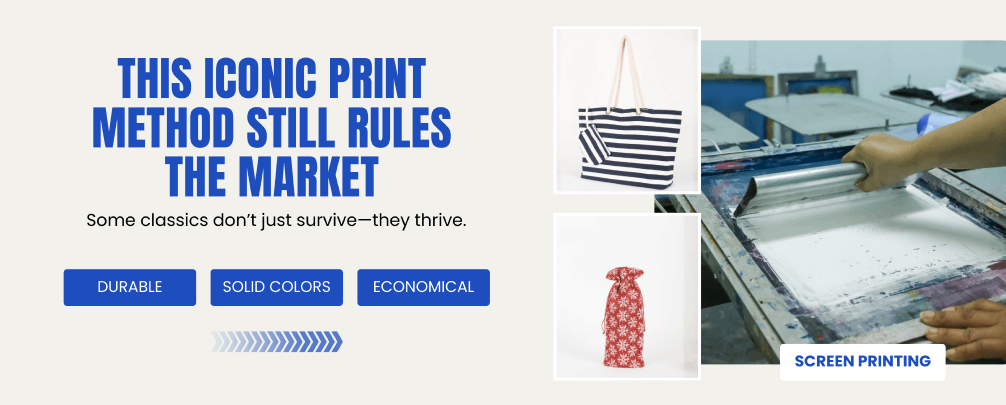
Why This Iconic Print Method Still Rules The Market
Featuring sustainable solutions by Kelvin Ecopack
Introduction
When it comes to print method on eco-friendly bags, there are many options that a customer may choose, like glitter, foil, digital, heat transfer, embroidery and the list goes on. However, even if there are new methods coming up in the market for printing, one technique continues to dominate the market. This method is popularly known as the silk or screen printing method.
Yes, this printing method has been going on since traditional times and is still considered one of the most cost effective and go-to methods for most buyers. It has been around for decades. There is a big reason why brands from boutique retailers to global exporters like Kelvin Ecopack still use it commonly and it works brilliantly.
A Little History Before the Hype
Screen printing isn’t new—it’s practically vintage. The earliest forms trace back to China in the Song Dynasty (960–1279 AD), where artisans pushed ink through stencils to create intricate designs on fabric. Fast forward to the 20th century and it became a favourite for posters, signage and of course, textile printing.
In today’s eco-conscious world, it’s found a second life on Jute, Juco, Cotton and Canvas bags, proving that some classics don’t just survive—they thrive.
Why this Print Method Works Like Magic on Eco Bags
The first reason brands love it? durability. Unlike printed stickers or heat transfers that can peel or fade, screen printing embeds ink deeply into the fabric. A screen-printed Jute or Cotton bag can survive hundreds of washes while keeping its vibrant colours intact. In practical terms, that means a bag that customers will reuse again and again—free advertising for your brand with every grocery trip, office run or holiday shopping spree.
Another reason? bold, solid colours. Screen printing is unmatched when it comes to logos, slogans or any design that demands punchy, saturated hues. On natural fabrics, especially Jute and Canvas, it creates a high-contrast, premium look that digital printing sometimes struggles to replicate. That’s why luxury eco-bag brands and retailers with high-visibility branding still choose it over newer techniques.And here’s a fun fact: a single screen print can last 3–5 times longer than standard heat transfer prints, and it maintains colour integrity without fading—even under strong sunlight. That’s marketing durability no billboard can compete with.
Scalable, Cost-Effective and Ready for Bulk
Here’s the behind-the-scenes reason screen printing dominates the market: scalability. When producing large quantities—think thousands of Christmas shopper bags, promotional totes or corporate gifting bags—screen printing is far more economical than digital or embroidery. Once your screens are set up, adding more bags doesn’t increase cost proportionally.
This makes it a favourite for bulk buyers, exporters, and retailers. You get consistent quality across hundreds or thousands of bags, ensuring every bag looks just as crisp as the first. And in the eco-bag world, that’s critical—because a flimsy or inconsistent print can ruin both the bag and your brand’s reputation.
Versatility That Surprises People
Even though screen printing is popularly known for bold, limited colour designs and modern colour methods allow for multi-colour masterpieces too. From gradients and metallic inks to glow-in-the-dark or water-based eco-friendly inks, the method has evolved to suit present day preferences without sacrificing its iconic durability.
Screen printing also works beautifully on textured surfaces like Jute or Canvas—fabrics that other methods, like digital printing or heat transfer, often struggle with. That’s why brands looking for high-quality Christmas shopper bags, tote bags or promotional products keep coming back to this classic technique.
Eco-Friendly by Nature
One of the best-kept secrets about screen printing is its compatibility with sustainable practices. Modern water-based inks and non-toxic pigments mean that screen printing is now as eco-conscious as the fabrics it’s printed on. Combine it with a reusable Jute, Cotton or Canvas bag and you have a product that’s visually stunning, durable and environmentally responsible.
It’s marketing gold: shoppers feel good about carrying a stylish bag that doesn’t hurt the planet—a combination that keeps customers coming back year after year.
Why Brands Still Choose It
Despite the rise of glitter, foil, heat transfers and digital printing, screen printing’s combination of durability, vibrancy, scalability and eco-friendliness makes it irreplaceable. It’s a method that can be classic or contemporary, festive or corporate, premium or playful.
For retailers, it’s simple math: the longer the bag lasts, the more your brand gets seen. The bolder the colours, the stronger the first impression. The larger the quantity you print consistently, the lower the cost per bag.
In short: screen printing doesn’t just print designs—it prints value.
The Takeaway
Screen printing is more than a “classic technique”—it’s an iconic tool that has adapted, evolved and stayed relevant for decades. On eco-friendly fabrics like Jute, Juco, Cotton and Canvas, it remains the go-to choice for brands that want longevity, quality and marketing impact.
At Kelvin Ecopack, we’ve seen it in action time and again: bold prints, perfect consistency and customers who keep bags for years. If you’re looking to make a lasting impression this holiday season—or any season—screen printing is still, without question, the reigning champion of bag printing methods.
Our products are compliant and cater to the requirements of the UK, Italy, Germany, the Netherlands, France, Spain, Ireland, Scotland, Romania, Bulgaria, Estonia, Russia, Malaysia, Singapore, Thailand, the UAE, Saudi Arabia, South Africa, Ethiopia, Mauritius, Seychelles, Chile, Peru, Mexico, and other countries.
Frequently Asked Questions:
1. Why is screen printing considered more durable than other print methods?
Ans. Screen printing pushes ink deep into the fabric instead of sitting on the surface, which prevents cracking and peeling. That’s why screen-printed eco bags last 3–5 times longer than heat-transfer prints.
2. Does screen printing work well on natural fabrics like jute and canvas?
Ans. Yes—and surprisingly, textured fabrics like Jute and Canvas actually improve ink grip. The fibers hold ink better, making prints bolder, sharper and longer-lasting than most other methods.
3. Is screen printing an eco-friendly printing option?
Ans. Modern screen printing uses water-based, non-toxic inks that are safe for natural fibers. When paired with reusable bags, it creates a low-impact, sustainable printing solution.
4. Is screen printing suitable for bulk bag production?
Ans. Absolutely—once the screens are set, producing large quantities becomes highly cost-efficient. This makes screen printing one of the most economical choices for bulk eco-bag orders.
5. Why do screen-printed bags offer better brand visibility?
Ans. The only reason behind this simple yet super effective method is that the prints don’t fade or peel easily, the bags stay in use for years. One reusable screen-printed bag can generate over 5,000 brand impressions in its lifetime.